Showing posts with label Astronomy. Show all posts

Monday, November 29, 2010

The Last Post Is On Comets.


There are so many amazing things in our universe we cannot even begin to find all the things there are out there.
Comets are balls of frozen water, dry ice and rocks. As they move, they leave behind a trail of dust and dirt.
Once a year, the Earth passes through a Comet's path. When the dust and stuff hits the Earth's atmosphere, the dust and dirt catch fire. We call this a meteor shower. The best time to see it is between August 9th to August 13th.
The word 'Comet' comes from the Greek word kometes which means head of hair. And actually the Comets do look like they have hair.
The hair is actually all the steam rising off the Comets as they go on their orbit around the sun.
A Comet's orbit can be 200 years! Of course, some Comets like Halley's Comet only take 76 years to go around the sun.

Well I hoped you liked Astronomy as much as I did!

Wednesday, November 17, 2010

All The Stars In Sky!!!


There are billions and trillions of stars in the sky and GOD said HE will call each one by name. So there must be a great deal of names!
Our sun is just a star we just named it ours. But there are others as big as our sun if not bigger. I can't remember all there names but there were like three that where really big! We watched a movie once which had the stars in it. They showed earth compared to the sun and earth was tiny then the sun to another star and the sun was just a speck and they kept doing this and the one before would be just a speck!
When Christopher Columbus sailed to America he flowed the stars. All the explorers flowed the stars.
When people talk about light year that's how many miles light can travel in a year which is- 5,900,000,000,000 miles in a year.
The best time to see the stars is on a clear day with no moon and you can see trillions of stars!!!!!!

Tuesday, November 16, 2010

The Black Holes!!

When a star runs out of fuel it collapses in to it's self. Sins the star is so hot when it does this it explodes!
After doing this most of the star gets shot in to space but a small amount of the core stays.
When this happens the small amount of core has a great deal of mass. (Which is the gravitational pull.) The mass pulls every thing around it in to it and it gets so very dark because no light can escape the gravity.
And so it's called the Black Hole.
Scientists see how Black Holes effected the surrounding things. For example gasses move very quickly when there is a Black Hole near.
The universe is getting bigger and bigger and so we are moving away from any Black Holes.

Thursday, November 11, 2010

Pluto!!!


Pluto is the last planet in our solar system and it is rather confusing so just try to stay with me.
Pluto is the smallest planet and it's number 9. But that's only part true. Every 248 years Pluto and Neptune change places Pluto becomes number 8. The last time Pluto became the 9th planet that was in 1999.
Pluto swaps with Neptune for about 20 years then goes back.
Scientists haven't been able to study Pluto very well because of it being so far away but they think it's about 390 degrees below zero over there. Pluto rotates in the opposite direction of most of the other planets and is like Uranus is on it's side.
All the planets orbit around the sun in all at more or less the same height but Pluto orbits up and down.
Pluto was discovered 1930 and 48 years later Pluto's moon Caron was discovered.
Earth's moon is equal to about a 50th of Earth's size but Caron is about a 6th of the size of Pluto.
Most People think that Pluto should be a comet because of it's size and behavior. But some think it should be a planet.
In 2006 NASA sent out a spacecraft that is supposed to reach Pluto in 2015.
Pluto also has something called the Kuiper belt which will probably need it's own post.

Monday, November 8, 2010

Neptune!!!

  • Neptune is the second to last planet.
  • It is a bright blue and it two wobbles while orbiting.
  • Like Jupiter and Saturn Neptune as storms raging on it all the time. Neptune has a spot. It's called the Great Dark Spot. Scientist think that the storms on Neptune are mad of diamond dust.
  • Neptune is smaller than Uranus it's inner core is rock and surrounded by liquid.
  • A year on Neptune is 164 earth years, and a day is 16 hours long.
  • Neptune is also very cold! It is 370 degrees below zero.
  • Neptune has 10 moons the biggest of which is Triton which is 400 degrees below zero and Triton is moving closer to Neptune every day.
  • So only 1 more planet to go.
  • Second to last.

Wednesday, November 3, 2010

Uranus!!!

  • Uranus is the second to last planet in our solar system!!!
  • Now most planets spin around the sun but Uranus rolls. Just imagine that Uranus has a North pole and a South pole. While Earth is spinning the poles are be up and down(More or less.). But Uranus's poles would be straight out on both sides while spinning so that means that Uranus is on it's side.
  • Uranus has 11 rings. The rings are straight up and down which effects Uranus orbiting and make it all wobbly.
  • Like Venus, Uranus spins the opposite way from all the other planets.
  • And being away from the sun Uranus is -350 degrees.
  • Like Saturn, Uranus's rings have dust, rocks and moons. Two of the moons are Cordelia and Ophelia. Two of the characters from one of Shakespeare's plays!
  • Believe it or not Uranus was only discovered in 1781 by William Herschel and his sister Caroline.
  • One year on Uranus is equal to 84 Earth years. And one day is 17 hours.
Wow!!!

Tuesday, November 2, 2010

Saturn!!!


  • Everyone remembers Saturn by it's rings.
  • There are thousand of rings made up of rocks, dust,and ice that orbit Saturn.
  • The rocks range in size from pebbles to houses and all the rings are different colors.
  • Also in the rings are moons just orbiting Saturn.
  • Saturn's ring is 50 miles thick.
  • Saturn is the second biggest planet because it is next in size to Jupiter.
  • Saturn is tilted just like the earth, but compared to Saturn the earth is a marble and Saturn is a soccer ball.
  • Like Jupiter, Saturn is made up of hydrogen and helium gas.
  • Being further away from the sun, Saturn is 300 degrees F. below zero on the surface and 20,000 degrees F. in the core of Saturn.
  • A Saturn year is 30 earth years. And an Saturn day is just about 10 hours.
  • Saturn has 30 moons and the moon that is almost as big as Saturn is Titan.
So, I think we've got every thing on Saturn.

Did you realize how many threes Saturn has?

Wow we are going through this very fast.


Friday, October 15, 2010

Jupiter yet again!!!


Jupiter is the biggest planet and the astronomers can also see Jupiter's spot and so it kind of stands out.


Most people see Jupiter's spot and if the can't tell at first they recognize it by it's spot.
Jupiter spot is called-(are you ready?) Great Red Spot.
But actually the spot isn't a spot at all but a giant storm many times stronger than the storms we have on earth.
The storm has been going on for at least 300 years!
The Great Red Spot is twice the size of earth.


Jupiter
has four moons: Io, Europa, Ganymede and Callisto, which I do believe I have told you about.

Since Jupiter is very far away from the sun so not much heat can reach it. But Jupiter has it's own source of heat.
In the core of Jupiter there are hot rocks that keep Jupiter warm.

Jupiter
's days are very short. One day is only 10 hours. But a full year is equal to 12 earth years.
Jupiter is one big ball of gas. It is almost all atmosphere.

Thursday, October 14, 2010

A little on Mars


The planet next in line is the planet Mars.
Mars is a lot like earth in that it has volcanoes, mountains and valleys.
But Mars is different from the earth because it has a thin layer of atmosphere and no oxygen.
Mars has two moons Phobos and Deimos. (Neither look much like moons.)
It takes two earth years for Mars to orbit the sun and and day on Mars is equal to 687 earth days.
Mars is always 81 degrees below zero. And the hottest it gets is 32 so my sister, Erin,(who doesn't like the cold)is glad we do not live there.
All though Mars is so cold it is closer to earth temperatures then any other planet.
Just like the earth Mars is at a tilt and so it has four different seasons:
Very Cold; A Little Warmer(32 degrees); Getting Colder and Very Cold Again. Just kidding!
But it does have four seasons.

Tuesday, October 12, 2010

Amazing Earth


Isn't it amazing how God made the earth?
We have atmosphere, gravity and oxygen.
If we were too close to the sun, or if we had to much atmosphere we would be like Venus or Mercury!
So you have to agree that every thing is just right!
We live on earth, so we already know a great deal about it, but here is just one thing that many people don't know much about.
The layers in the earth.
There are four - the Crust, the Mantle, the Outer Core and the Inner Core.
So that's good old earth!

(Boy we are moving through this pretty fast!)

Monday, October 11, 2010

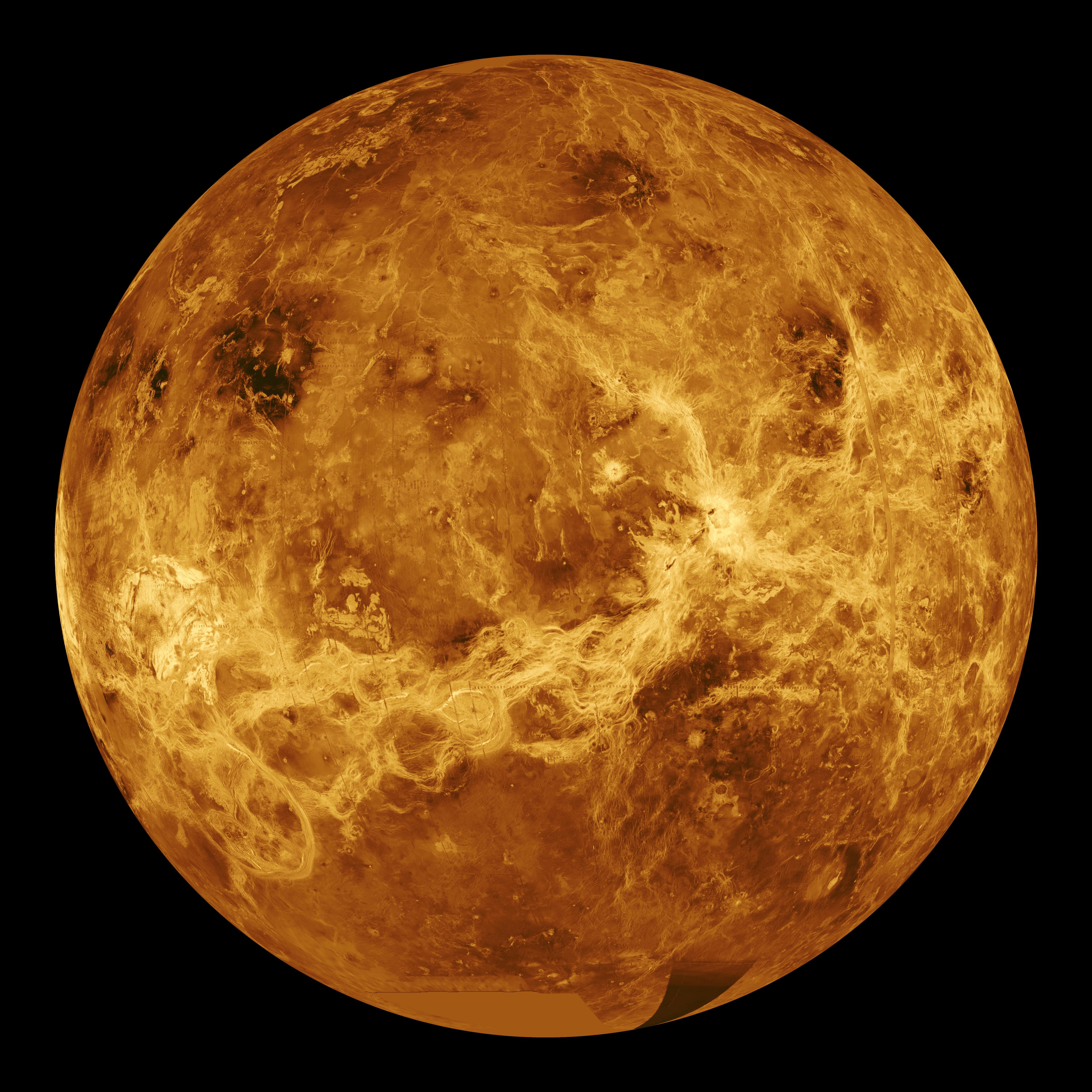
Venus


Extremely hot!!!
Venus is one big planet of volcanoes and atmosphere that keeps all the heat in.
Venus has so much atmosphere that it just keeps getting hotter and hotter.
Did you know that a year on Venus is 225 earth days?
And a Venus day is 243 earth days?
Odd! You could have a birthday every day!

Thursday, October 7, 2010

Short Post


Did you know that scientist have a hard time taking pictures of Mercury because it is so close to the sun?

Tuesday, October 5, 2010

Orbiting

When something just spins in a circle it's called "rotating" and when something spins around another object it's called "revolving" but when something rotates and revolves it's called "orbiting."
The earth takes 24 hours to rotate which is one earth day.
And a full circle around the sun is one year.
On Mercury it takes 59 earth days to rotate one time.
And just under 30 earth days of being hot and 30 earth days of cold dark.
All that to say that it's 88 earth days to make one Mercury year.
Well that is enough on Mercury for today.

(Sorry there aren't any pictures!)

Thursday, September 30, 2010

Mercury!!!


Mercury is the next planet to the sun and so we are not able to observe it well because of the sun.
The only space craft that has ever gotten very close is the "Mariner 10."
The Mariner 10 got some information on Mercury but not much.
Mercury, during the day, gets up to 750 degrees!
So being so close to the sun it would never get cold? Not!
During the day it's unbelievably hot but at night it gets to be -300 degrees!
COLD!!!
Well the reason that Mercury doesn't have the layer of gasses called atmosphere to keep the heat in so at night it just keeps getting colder and colder and colder and colder.
Because Mercury doesn't have any atmosphere the sky is always gray.

Wednesday, September 29, 2010

Solar Eclipse

Alright, last day on the old sun!
So a solar eclipse happens once or twice a year when the moon goes over the sun and causes a shadow to pass over the earth. Sometimes it happens up to five times a year! Which is really cool because I thought it was when the clouds come over the sun but this is a different kind.
For a solar eclipse the moon covers the sun and makes it appear to be night! And even some animals get ready for bed.
But a Solar eclipse only happens for a minute or two.
You can also find websites that will tell you when the next solar eclipse in your area is and when it is and then you can watch it.
Although not to be "Johnny Rain Cloud" but the sun still peeks around the moon and you could hurt your eyes so maybe you should find some pictures instead and you also wouldn't have to go anywhere.

(Sorry, no pictures!)

Monday, September 27, 2010

Color


How do we get color?
Well the sun shines a white light which contains all the colors in the rainbow.
Light goes in a stright line. That is pretty easy to figure out because when you but your hand in front of a light it makes a shadow.
Then how do we get color?
OK. Light is a form of energy The Light travels in a straight line but the colors although going in a straight line are wavy, and each wave is a different size.

Blue is a short wave and yellow is a long one.
Then when the white light hits a object the white light is absorbed.
Some waves are absorbed but some aren't. Instead the wave bounces off your the object and up into your eyes.
When your eyes see a blue object you are really seeing a yellow wave. Your eyes see it and your brain recognizes it, and makes it appear blue.

Now if there was no eye there to see the object, blue light would still bounce off the object, but would not go to anyone's eye as blue. It would just bounce up until it hit an object that would absorb it.

So here's a question: Is the blue object still blue if there isn't a eye to see it?
(If you find out please tell me.)

And by the way the sun is orange because of the atmosphere around it.

Sun spots!

Sun spots are spots on the sun that are cooler than the rest of the sun.
When the number of spots is large Scientist think that there is a lot of activity going on inside the sun.
Many scientists believe that sunspots affect the weather here on earth.
Without the sunspots the earth would be cooler than it is today.
And if there were to many sun spots the earth would be hotter than it is today rain would not fall and this would cause a drought.

GOD has made everything just right.

Sorry that there aren't any pictures.

Thursday, September 23, 2010

Jupiter's Moons

Last night we heard that we could see Jupiter and it's four moons.
So we went outside and ate a picnic dinner while we watched the moons.

Jupiter is only separated from us by one planet. Mars.


So we got our binoculars. Put them on our tripod and watched the moons and got to see them move across the sky.
Pretty cool!

Jupiter's four moons are:
Europa, an icy moon.
Io is a colorful moon because of all the sulfer.
Callisto; all ice and rock.
And Ganymede is a lot bigger than Jupiter.

So whats the difference between a planet and a moon?
A planet orbits the sun, and a moon orbits the planet.


(Well I hope I haven't gotten to boring yet!)

Wednesday, September 22, 2010

In the Beginning

All righty!

Now I have never done anything like this before! So if it gets boring I'm sorry!
I think will get better with time so - here goes!!!!

I am going to start with Astronomy. I don't know why, but I am. First goes first or something like that and the first is...(Building up suspense!)


You ready?

The first is...What does Astronomy mean? And the answer is "The Study of the Universe"

The universe is full of fascinating things! Planets, moons, stars, galaxies and so many more things all wrapped up in one big universe for us to study!
So enjoy!
~Emily.